Hoover Dam
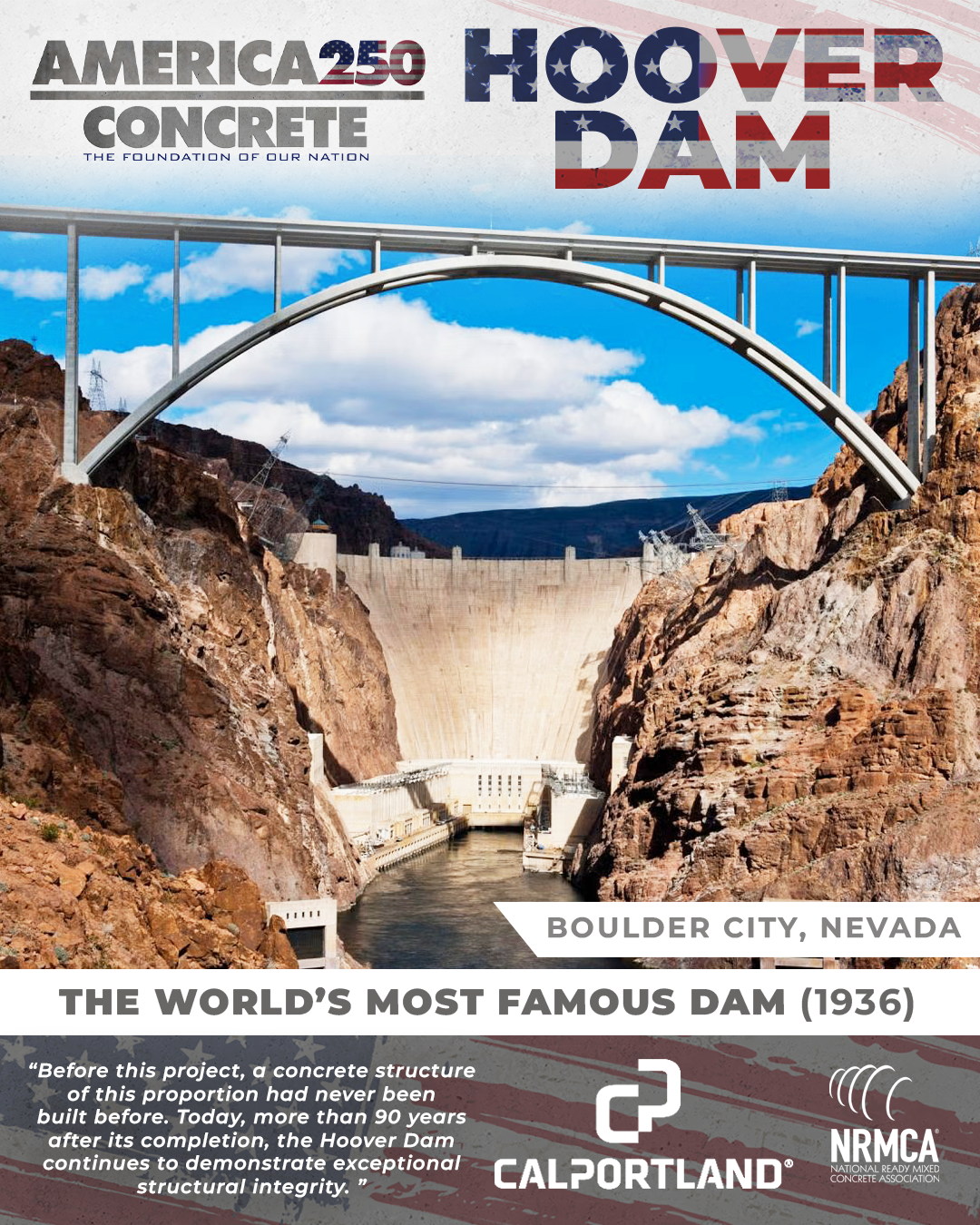
As early as the late 1890’s, as development grew in the Southwest United States, the Colorado River was seen as a potential source for irrigation water for Southern California and the Imperial Valley. In 1928, Congress authorized the Hoover Dam Project. Of the three valid bids submitted, the winning bid of $48,890,955 was within $24,000 of the confidential government estimate of what the dam would cost, and $5,000,000 less than the next-lowest bid.
The Bureau of Reclamation (BOR) considered different types of dams to be used but eventually decided on a massive concrete arch-gravity dam, the design of which was overseen by the Bureau’s chief design engineer John L. Savage. The monolithic dam would be thick at the bottom and thin near the top and would present a convex face towards the water above the dam. The curving arch of the dam would transmit the water’s force into the abutments, in this case the rock walls of the canyon, enhancing stability and strength. The wedge-shaped dam would be 660 ft. thick at the bottom, narrowing to 45 ft. at the top, leaving room for a highway connecting Nevada and Arizona.
With a base as thick as two football fields are long, the amount of concrete used in building was enough to pave a two-lane highway stretching from San Francisco to New York City. When it was completed in 1935, Hoover Dam was the highest dam in the world, standing as tall as a 60-story building. Such a large concrete structure had never been built before, and some of the techniques used were unproven. The torrid summer weather and lack of facilities near the site also presented difficulties. Nevertheless, the dam was turned over to the federal government on March 1, 1936, more than two years ahead of schedule.
To protect the construction site from the Colorado River and to facilitate the river’s diversion, two cofferdams were constructed. Work on the upper cofferdam began in September 1932, even though the river had not yet been diverted. The cofferdams were designed to protect against the possibility of the river’s flooding a site at which two thousand men might be at work, and their specifications were covered in the bid documents in nearly as much detail as the dam itself. The upper cofferdam was 96 ft. high, and 750 ft. thick at its base, thicker than the dam itself. It contained 650,000 cubic yards of material. When the cofferdams were in place and the construction site was drained of water, excavation for the dam foundation began. For the dam to rest on solid rock, it was necessary to remove accumulated erosion soils and other loose materials in the riverbed until sound bedrock was reached. Work on the foundation excavations was completed in June 1933. During this excavation, approximately 1,500,000 cubic yards of material were removed.
Once cleared, the underlying rock foundation of the dam site was reinforced with grout, forming a grout curtain. Holes were driven into the walls and base of the canyon, as deep as 150 feet into the rock, and any cavities encountered were to be filled with grout. This was done to stabilize the rock, to prevent water from seeping past the dam through the canyon rock, and to limit the upward pressure from water seeping under the dam.
The first concrete was placed into the dam on June 6, 1933, 18 months ahead of schedule. Since concrete experiences thermal expansion and contraction as it cures, the potential for uneven cooling and contraction of the concrete posed a serious problem. Bureau engineers calculated that if the dam were to be built in a single continuous pour, the concrete would take 125 years to cool, and the resulting stresses would cause the dam to crack and crumble. Instead, the ground where the dam would rise was marked with rectangles, and concrete blocks in columns were poured, some as large as 50 feet square and 5 feet high. Each five-foot form contained a set of 1-inch steel pipes through which cool river water would be poured, followed by ice-cold water from a refrigeration plant. When an individual block had cured and had stopped contracting, the pipes were filled with grout.
The concrete was delivered in huge steel buckets 7 feet high and almost 7 feet in diameter, which were filled at two massive concrete plants on the Nevada side, and were delivered to the site in special railcars. The buckets were then suspended from aerial cableways which were used to deliver the bucket to a specific column.
A total of 3,250,000 cubic yards of concrete were used in the dam before concrete placement ceased on May 29, 1935. In addition, 1,110,000 cubic yards were used in the power plant and other works. More than 582 miles of cooling pipes were placed within the concrete. Concrete cores removed from the dam for testing in 1995 showed that the concrete has continued to slowly gain strength resulting in concrete having a compressive strength exceeding the range typically found in normal mass concrete.
Lake Mead, formed by Hoover Dam, is the largest reservoir in the US. Releases from the dam provide water for both municipal and irrigation use. In total, water from Lake Mead serves 18 million people in Arizona, Nevada, and California and supplies irrigation for over 1,000,000 acres of land.
Today, more than 90 years after its completion, Hoover Dam continues to demonstrate exceptional structural integrity. The concrete has withstood decades of environmental and operational stress. Hoover Dam was engineered for longevity and engineers expect the structure to remain in service for centuries.
Over time, Hoover Dam has become a symbol of popular culture, appearing in films, video games, literature, and documentaries. The 2007 film Transformers featured the dam’s Black Canyon location, while video game franchises such as Fallout have incorporated the structure into their storylines. The dam has also been the subject of numerous historical and nonfiction works, including Life and Death at Hoover Dam.
Hoover Dam was recognized as a National Historic Civil Engineering Landmark in 1984. It was listed on the National Register of Historic Places in 1981 and was designated a National Historic Landmark in 1985, cited for its engineering innovations. Nearly one million visitors tour the dam annually. For America’s 250th birthday, a massive American flag (300 feet wide and 150 feet tall) was displayed on the Hoover Dam. It was unveiled on Memorial Day. The patriotic display concluded and the flag was lowered for the last time on July 6, 2026.
NRMCA Member’s Role

For more than nine decades, Hoover Dam has proven to be resilient, become a symbol of popular culture, and attracted millions of visitors. CalPortland is proud to have contributed to such a historical landmark that continues to serve for generations to come.