Tunkhannock Creek Viaduct: The World’s Largest Concrete Railroad Bridge
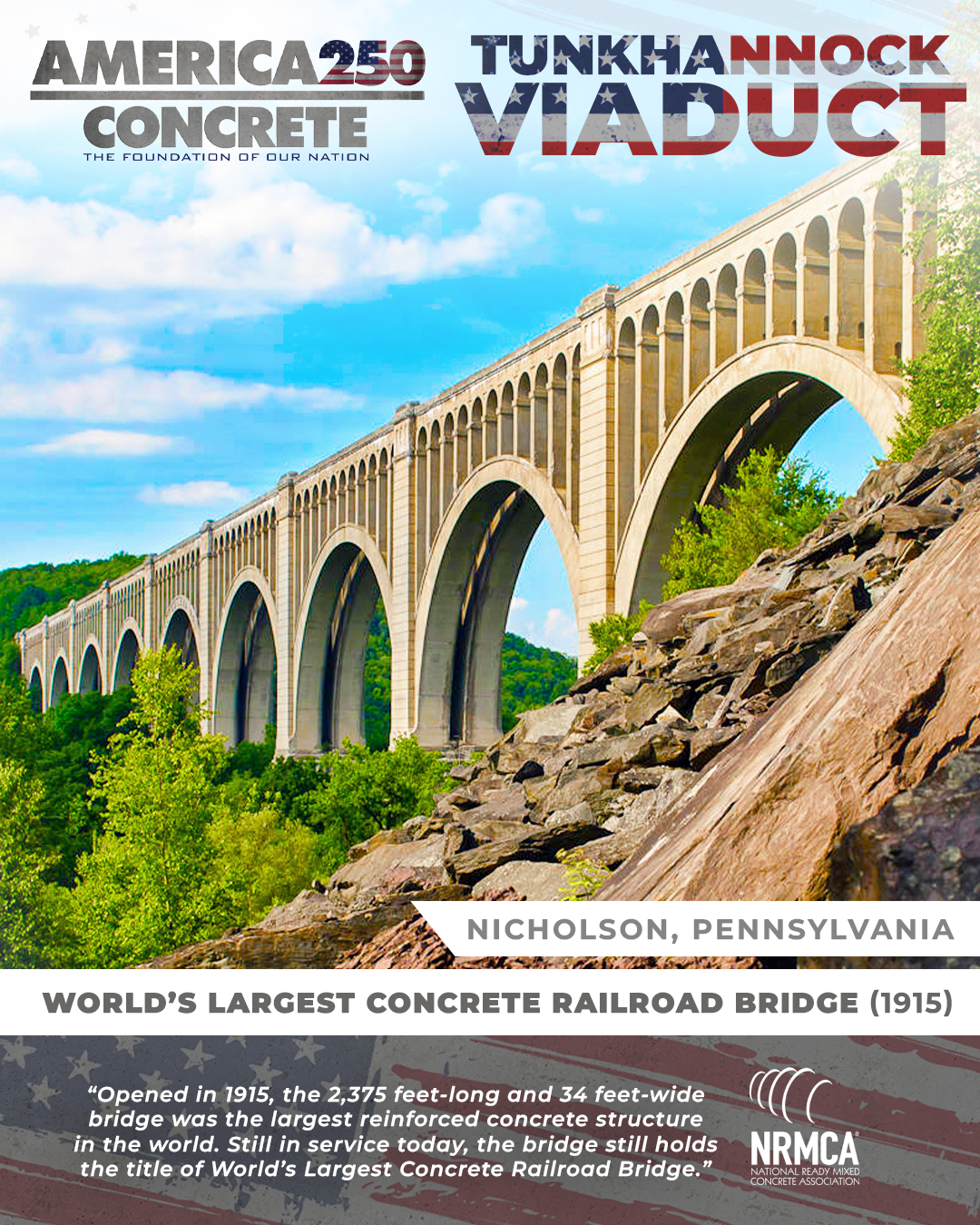
The Tunkhannock Creek Viaduct (also known as the Nicholson Bridge) is a concrete deck arched bridge on the Nicholson Cutoff rail line segment of the Norfolk Southern Railway’s Sunbury Line that spans Tunkhannock Creek in Nicholson, Pennsylvania. Opened in 1915, the 2,375 feet-long and 34 feet-wide bridge was the largest reinforced concrete structure in the world. Still in service today, the bridge still holds the title of World’s Largest Concrete Railroad Bridge. The bridge carries two tracks 240 feet above the Tunkhannock Creek streambed.
Built by the Delaware, Lackawanna and Western Railroad (DL&W), the bridge was designed by DL&W’s Abraham Burton Cohen, with the concrete sections being designed by architect William Hull Botsford. Other key DL&W staff were G. J. Ray, chief engineer; F. L. Wheaton, engineer of construction; and C. W. Simpson, resident engineer in charge of the construction. The design attracted the attention of many railroad builders, as they did not believe reinforced concrete was sturdy or durable enough to handle the load.
Part of DL&W’s twelve-million-dollar New Milford cut-off project, the $1.4 million contract to build the bridge was awarded to Flickwir & Bush, who specialized in railroad construction. A crew of approximately five hundred workers, less than half of whom were skilled, worked 24 hours a day to complete the project in just three and a half years.
Construction of the bridge began in May of 1912 and was, itself, an engineering feat. Giant wooden towers were built at the ends (each 169 feet tall) and at the center (300 feet tall) of the construction site to support an aerial tramway. A system of cable cars, riding wires suspended from towers at each side of the valley, transported steel falsework, wooden forms, concrete, and other construction material for the piers and arches.
Eleven piers were sunk to bedrock, some as much as 138 feet below the surface. The builders encountered quicksand beneath two of the pier locations, requiring additional excavation. In total, over thirteen million cubic yards of material were removed. Almost half of the bulk of the bridge is underground.
Nearly 35,000 tons of Portland cement were brought to the site by railcar and combined with local aggregates in an on-site concrete mixer. Approximately 4,000 feet of narrow-gauge track was utilized beneath the towers, over which fourteen flatcars and four “Dinky” engines hauled the reinforcing steel and buckets of concrete from the mixer to the hoist where they were lifted to the tramway.
In all, 1,140 short tons of steel and 167,000 cubic yards of concrete were used in constructing the bridge, which author Theodore Dreiser described as, “a thing colossal and impressive.”
In 1975, the American Society of Civil Engineers designated the bridge as a National Historic Civil Engineering Landmark. The bridge was listed on the National Register of Historic Places on May 3, 1977.
In June 2026, Union Pacific’s Big Boy No. 4014, the largest and heaviest steam locomotive still in operation, crossed the bridge on its coast-to-coast run enroute to Philadelphia to celebrate America’s 250th Anniversary.