Space Needle: Seattle’s 605-Foot Icon, Anchored in Concrete
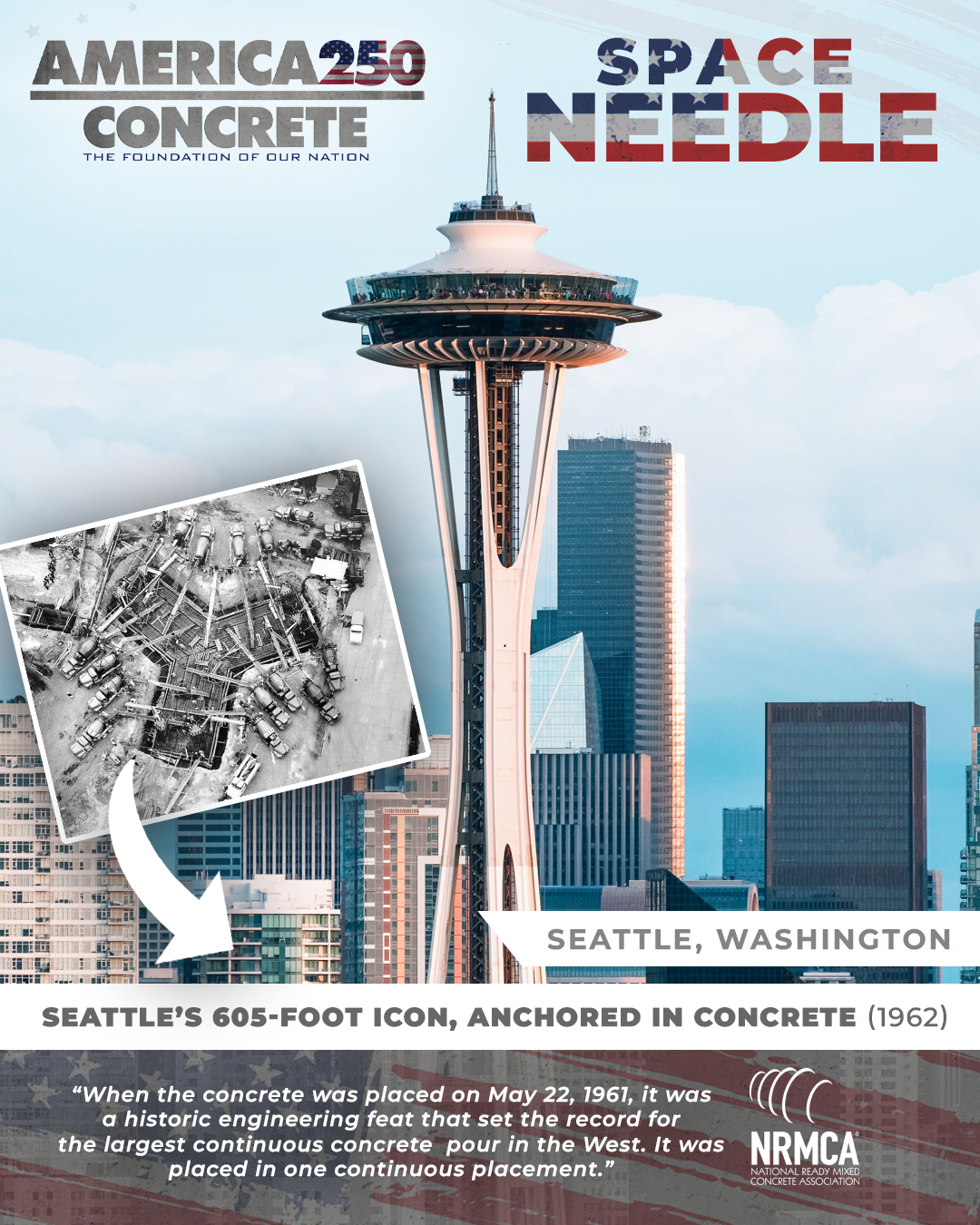
Rising 605 feet above the city, the Seattle Space Needle is one of the most iconic landmarks in the world. Built for the 1962 World’s Fair, it was once the tallest building west of the Mississippi River.
The architecture of the Space Needle is the result of a compromise between the designs of two people, local businessman Edward E. Carlson and architect John Graham, Jr. Carlson’s sketch on a napkin depicted a giant balloon tethered to the ground while Graham’s concept was of a flying saucer. Architect Victor Steinbrueck introduced the hourglass profile of the tower and its tripod design, which resembles the isthmus on which Seattle is located.
As with any project, the building is only as good as its foundation. And ready mixed concrete provides the solid base that allows for the resilient design that towers above.
The foundation weighs 5,850 tons, the same as the above-ground structure. The combined weight of the concrete and steel foundation perfectly matched the weight of the above-ground tower. This heavy underground block anchored the structure so deeply that the Space Needle’s center of gravity is actually below ground level. This engineering design keeps the tower highly stable against earthquakes and high coastal winds.
The tower is 605 feet tall and 138 feet wide. Built with steel and glass anchored by concrete, the Space Needle is designed to withstand winds of up to 200 miles per hour with swaying of only one inch per ten mph, and earthquakes of up to 9.0 magnitude. The Nisqually earthquake of 2001 was a 6.8 magnitude quake that caused over $2 billion worth of damage across Washington state. But the impact on the Space Needle was limited to some water sloshing out of the toilets.
The concrete base of the Space Needle is designed in a Y-formation, 30 feet deep and 120 feet across. Workers from the Howard S. Wright Construction Company packed the pit with 250 tons of reinforcing steel rebar. They embedded 72 massive steel anchor bolts measuring 31.5 feet long and 4 inches in diameter to secure the tower’s legs.
When the concrete was placed on May 22, 1961, it was a historic engineering feat that set the record for the largest continuous concrete pour in the West. It was placed in one continuous placement. Ready mix trucks from Pioneer Sand and Gravel made a total of 467 trips over twelve straight hours to complete the placement and to prevent any structural weak joints. The trucks successfully placed 2,800 cubic yards of concrete.
Pioneer Sand & Gravel later became Glacier Northwest. In 2005, Glacier Northwest merged with California Portland Cement company to form NRMCA member company CalPortland.
Construction of the Space Needle was completed in less than a year, and just one day before the April 21, 1962, opening of the World’s Fair. Over the course of the Fair, a total of 2.56 million people visited the Needle. Today, the tower includes a café and gift shop on the Observation Level, and a bar/lounge that incorporates the revolving glass floor on the Loupe Level. The City of Seattle Landmarks Preservation Board has designated the tower as a historic landmark.