Woodward Avenue: The First Mile of Concrete Highway
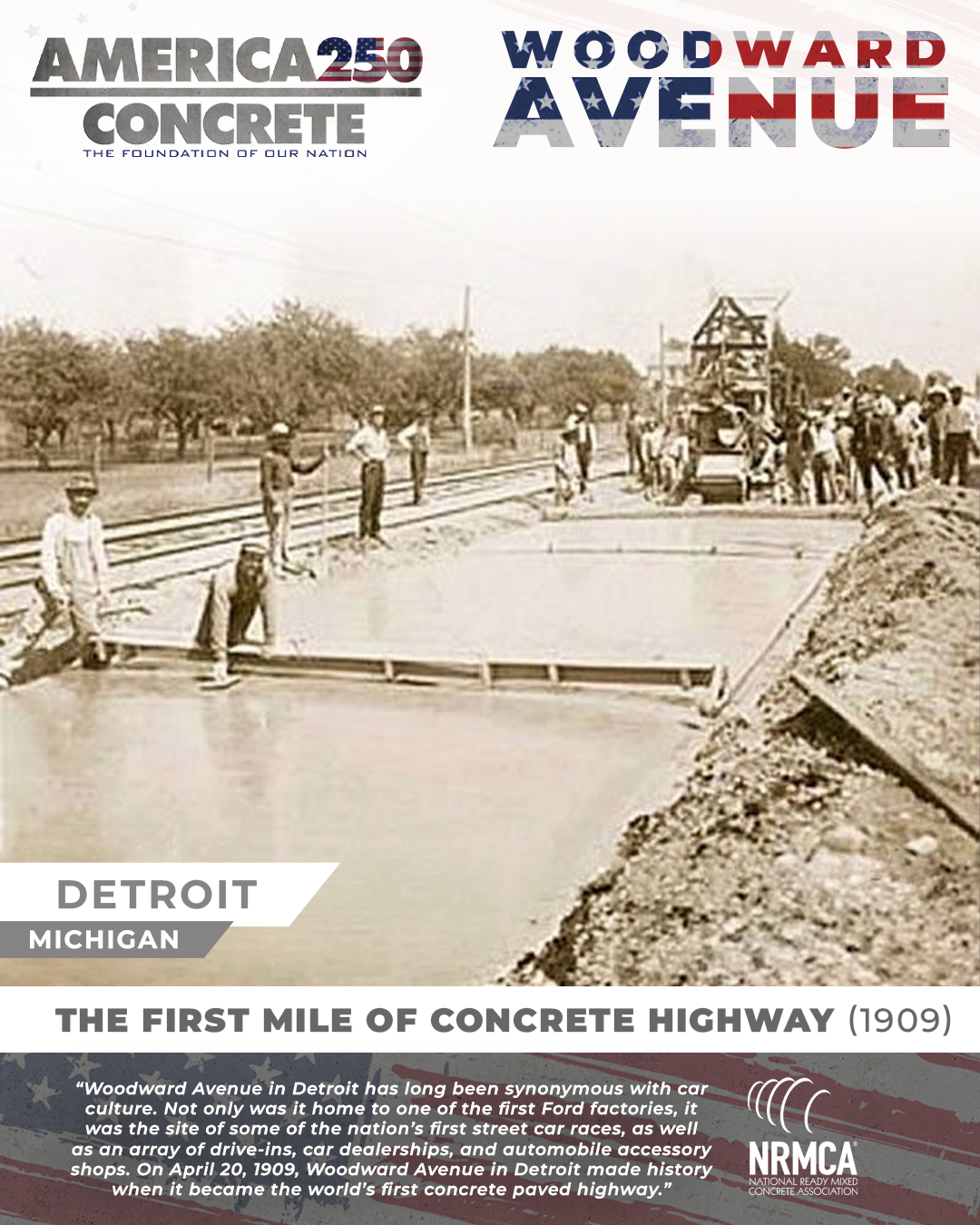
Woodward Avenue in Detroit has long been synonymous with car culture. Not only was it home to one of the first Ford factories, it was the site of some of the nation’s first street car races, as well as an array of drive-ins, car dealerships, and automobile accessory shops. On April 20, 1909, Woodward Avenue in Detroit made history when it became the world’s first concrete paved highway.
The street is named after Augustus B. Woodward, a judge appointed by President Thomas Jefferson, who led the city of Detroit beginning in 1805, during Michigan’s early years as a territory. Like most roads of that time, Woodward Avenue was designed primarily for horse-drawn carriages: a dirt road that became rutted with mud in the spring.
In 1904, Henry Ford opened a series of progressively larger factories near and along Woodward Avenue. Detroit had become a national hub for the automotive and auxiliary industries, and Woodward Avenue had become its Main Street. By this time, Wayne County Commissioners had decided that the road needed to be improved.
The Woodward Avenue road construction, carried out by Wayne County, came at a time when most streets in the Motor City were lined with brick pavers, with wood, ground granite, asphalt, dirt, or clay sometimes used. Robert D. Baker served as the primary construction contractor, working alongside engineer George A. Burley and Wayne County Road Commissioner Edward N. Hines, who conceptualized the experiment.
The section included one mile between Six Mile Road and Seven Mile Road. The total contract cost for this historic single mile was $13,537 (roughly $14,000 in total county accounts), which included $1,000 in state funding. By 1916, the road was paved for twenty-seven miles, all the way to Pontiac, Michigan.
The original concrete pavement was replaced in 1922 when Wayne County Commissioners approved the widening of the road to four lanes in each direction, with trolley tracks running between the lanes. Reinforced concrete was the pavement of choice for the reconstruction. The first phase of the reconstruction was completed in November 1924. However, due to complications with re-routing existing railways, the project was not totally completed until November 3, 1939.
In 1957, a Michigan historical marker was erected at the Woodward Avenue site on the grounds of Detroit’s Palmer Park. Paving Woodward Avenue in concrete was certainly a very innovative concept for that time. It most certainly paved the way for the 53,350 miles of concrete road and 90,000 miles of composite pavement in service today.