William E. Ward House
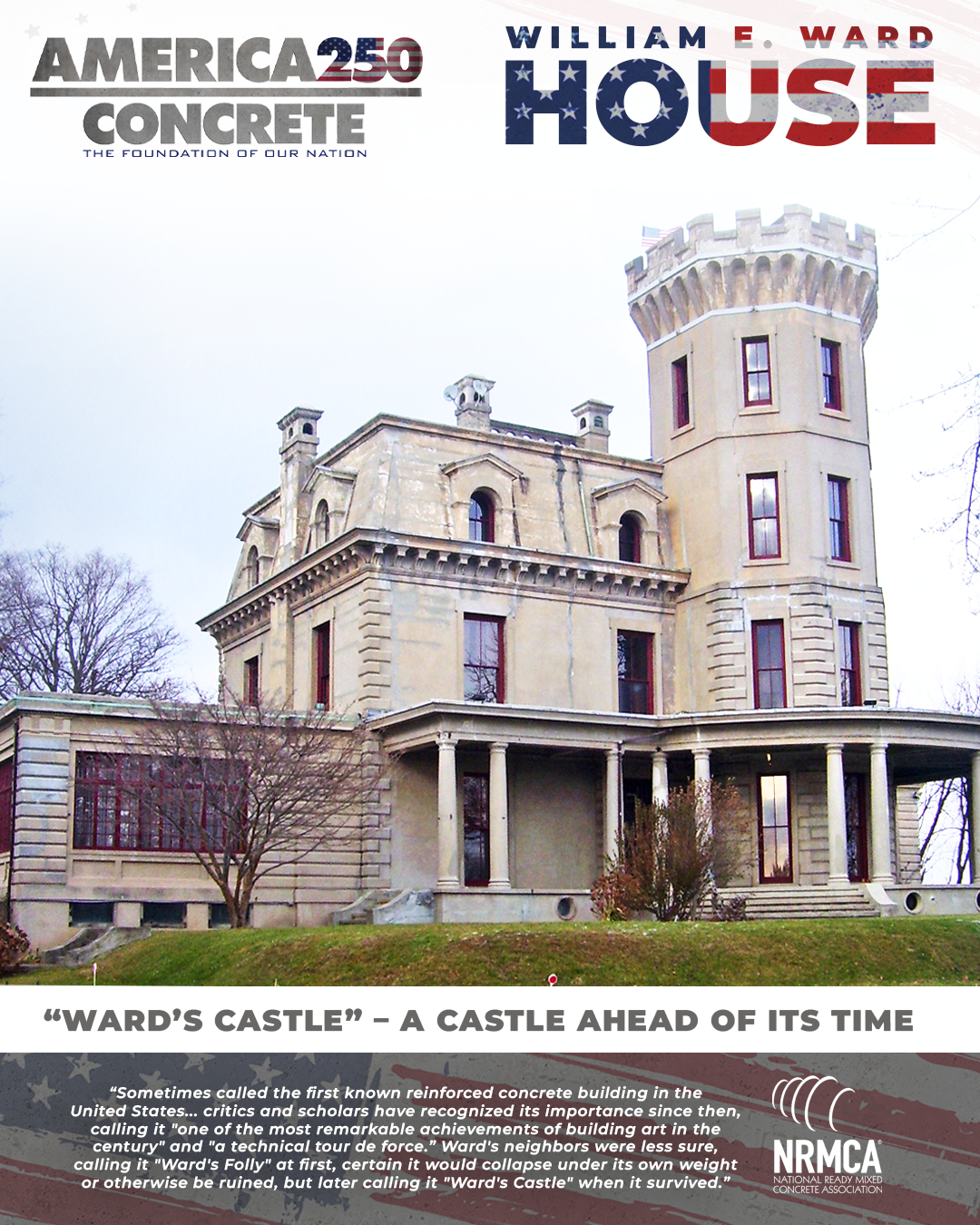
The William E. Ward House, known locally as Ward’s Castle, is located on Magnolia Drive, on the state line between Rye Brook, New York and Greenwich, Connecticut. It is a reinforced concrete structure built in the 1870’s and named after its builder, William E. Ward. A mechanical engineer, Ward designed the house to demonstrate the viability of concrete as a building material. Built between 1873 and 1876, it is considered to be the first and oldest extant reinforced concrete building in the United States.
Ward worked in collaboration with architect Robert Mook over three years to build the house. His goal was not only to build a house for himself, but that it be effectively fireproof. It’s believed that Ward’s mother, who lived with him, suffered from pyrophobia (fear of fire), and he wanted to build her a fireproof home.
The building is made entirely of reinforced concrete, from the foundation to the mansard roof that caps the two-story main block. A four-story tower with decorative parapets rises above the southeast corner. Like the house, it has imitation quoins on the corners of its lower two stories. A one-story wing projects to the west. A second tower serves as a water tower, meant to offer additional fire protection as well as a drinking supply. Wood was only used for door and window frames and their decorative trim. Approximately 3,000 cubic yards of concrete were used to build the complete structure.
No attempt was made to disguise the reinforced concrete. Rather, the design stressed concrete’s character as a building material. The structure demonstrated the practicability of reinforced concrete as a construction material for fireproof permanent structures. It also introduced the building industry to a new type of construction that was to proliferate throughout the United States, promoting the nation’s development.
Architectural publications carried articles about the house as early as year before construction was finished. Its completion in 1876 prompted even longer articles and mentions in overseas publications. Seven years later, in 1883, Ward presented his own paper on the house’s construction to the American Society of Mechanical Engineers.
Sometimes called the first known reinforced concrete building in the United States (although the Coignet Building in Brooklyn, New York was completed over the winter of 1872-73) critics and scholars have recognized its importance since then, calling it “one of the most remarkable achievements of building art in the century” and “a technical tour de force.” Ward’s neighbors were less sure, calling it “Ward’s Folly” at first, certain it would collapse under its own weight or otherwise be ruined, but later calling it “Ward’s Castle” when it survived.
Mort Walker, creator of the comic strip Beetle Bailey, purchased the home in 1976 and used it to house the Museum of Cartoon Art from 1976 to 1992. After the museum closed, the property returned to private ownership, and it remains a private residence. It has remained mostly unaltered, save for the addition of two modern wings.
The Ward House was listed on the National Register of Historic Places in 1976. The following year, the structure was jointly designated as a National Historic Civil and Concrete Engineering Landmark by the American Concrete Institute and the American Society of Civil Engineers.