The William Howard Taft Bridge
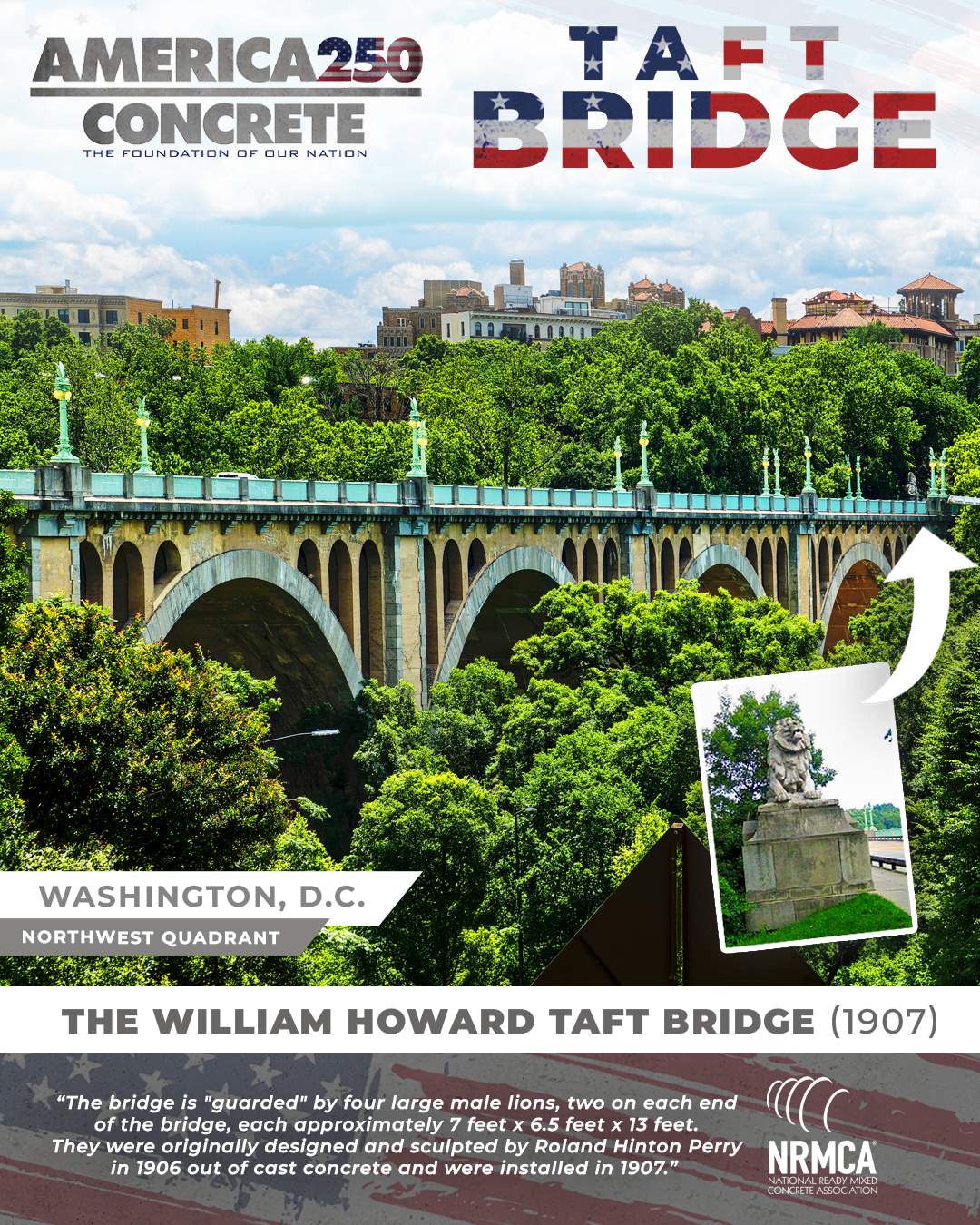
The William Howard Taft Bridge (originally known as the Connecticut Avenue Bridge) is a historic bridge located in the Northwest quadrant of Washington, D.C. It carries Connecticut Avenue over the Rock Creek gorge, connecting the neighborhoods of Woodley Park and Kalorama.
Designed by engineer George S. Morison and architect Edward Pearce Casey, the monolithic arch bridge is a Classical Revival design, constructed with unreinforced concrete arches and a reinforced concrete deck. The total length of the bridge between its abutments is 1,068 feet and it is 52 feet wide. Construction of the bridge took ten years, from 1897 to 1907. The project was overseen by U.S. Army engineer Henry C. Newcomer. It has been called an “engineering tour de force” and is recognized as the oldest and largest unreinforced concrete bridge in the world. In 1931, the bridge was renamed in honor of U.S. President William Howard Taft, who frequently walked the bridge while Chief Justice of the United States.
During early planning for the Washington Metro in the 1960s, the Red Line was slated to run across the bridge to connect Dupont Circle and Woodley Park. Instead, the metro was built underground.
The bridge is “guarded” by four large male lions, two on each end of the bridge, each approximately 7 feet x 6.5 feet x 13 feet. They were originally designed and sculpted by Roland Hinton Perry in 1906 out of cast concrete and were installed in 1907. In 1964 the lions were restored and weatherproofed by Washington-based sculptor Renato Luccetti, although this restoration proved to be less than entirely successful. When a rehabilitation of the bridge began in 1993, the lions, which were in very bad condition, were removed for further restoration but were found to be beyond restoring.
The United States Commission of Fine Arts worked with the city to oversee the production of the replacement lions that now sit on the bridge. Sculptor Reinaldo Lopez-Carrizo of Professional Restoration produced molds based on the existing sculptures and photographs and used them to cast new concrete lion sculptures that were installed on the bridge in July and August 2000. The same molds were used to cast bronze lions installed at the main pedestrian entrance to the National Zoo farther north on Connecticut Avenue in 2002.
Twenty-four lampposts are equally spaced along both sides of the Taft Bridge. Created by sculptor Ernest Bairstow in 1906, the lampposts are composed of concrete bases averaging five feet high, eight inches deep and four feet wide, with 17 feet high painted iron lampposts set in them. Each lamppost is topped with a painted iron eagle with its wings spread.
The Taft Bridge was added to the National Register of Historic Places on July 3, 2003.