Invention of the Concrete Mixer Truck
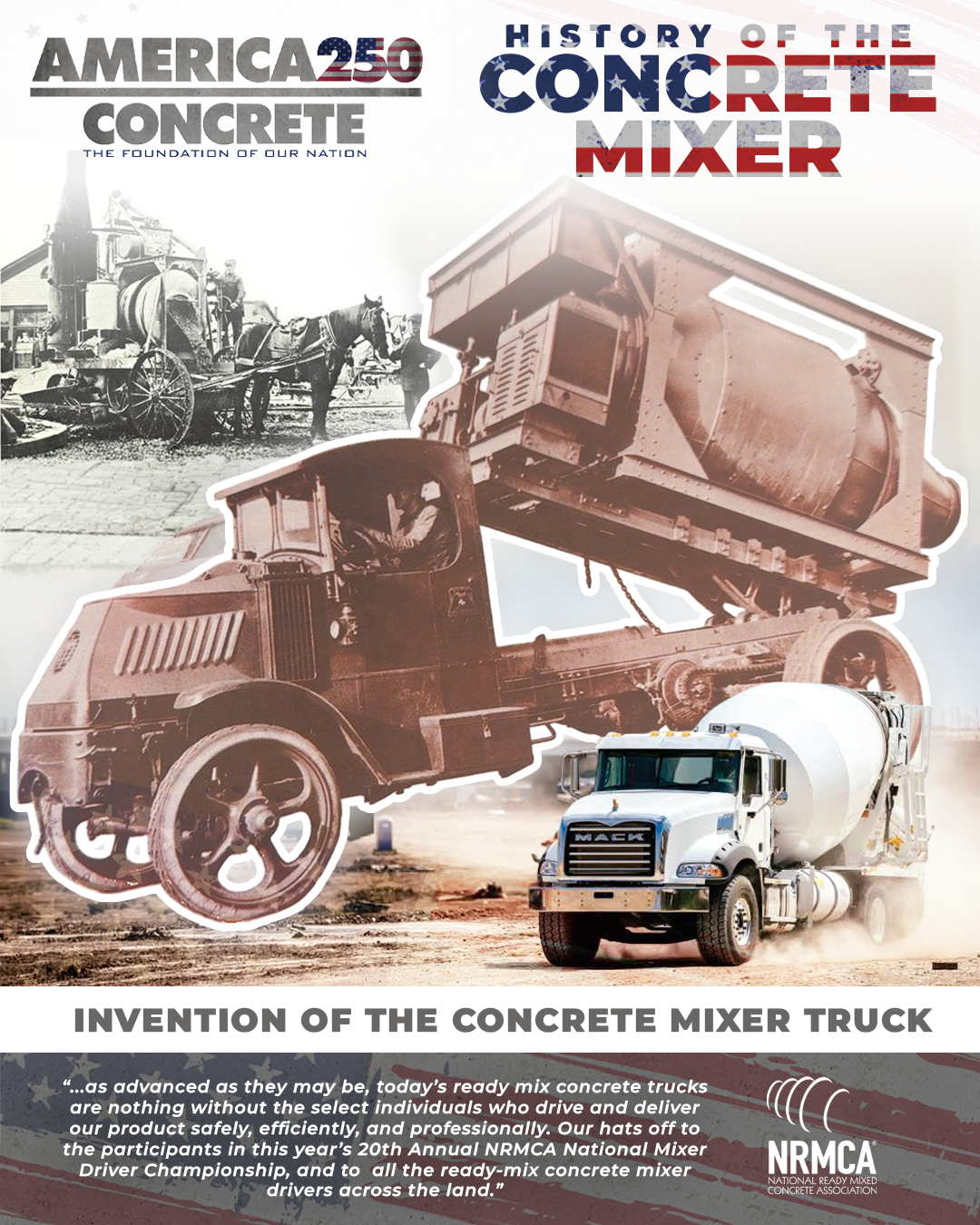
As a salute to the participants in NRMCA’s 20th Annual National Mixer Driver Championship recently held in Nashville, TN, this week America 250 Concrete highlights the invention of the ready-mix concrete mixer truck.
The invention of the concrete mixer truck marked a change in the way we build. Prior to its introduction, concrete was batched and mixed in stationary mixing plants and transported to the jobsite. The concrete mixer truck allowed for transit mixing of the concrete which provided a more homogenous concrete mix upon delivery and allowed workers ample time to place and finish without the concrete drying out. Today, the ready-mix concrete mixer truck is a staple on just about every jobsite.
The first recorded version of the portable concrete mixer was horse-drawn. It was patented in 1904, by German inventor Richard Bodlaender who gave it the title ‘Mortar Mixer’. The front wheels were replaced by a large drum that contained paddles for churning the concrete and as the horses pulled the vehicle, the wheel would turn, creating the mixing action. Though his machine was extremely heavy and would take horses a long time to transport the mixer from place to place, Bodlaender’s creation was a key moment. It allowed for mixing concrete faster and more efficient.
Stephen Stepanian, an Armenian-American inventor and quarry president in Ohio, designed the first self-discharging motorized transit mixer and filed for a patent in 1916. However, the U.S. Patent Office initially rejected it due to there being no previous patents around what he was designing, resulting in a lack of proof that the integration of the mixer and truck would work. Patent officials doubted a truck chassis could handle the weight of the equipment and the two cubic yards of concrete it would hold.
Stepanian reapplied for the patent in 1928, which finally received approval in 1933. Stepanian is often referred to as the father of the “ready-mix” concrete industry and has received universal recognition for his contributions to the industry. At the 1954 National Ready Mixed Concrete Association (NRMCA) convention in Chicago, he was made an honorary life member of the NRMCA Board of Directors.
Because of Stepanian’s initial patent delay, Ackert Bickel secured an early patent in 1920 for a motorized concrete truck, creating one of the first working fleets in Kansas City. (Due to Stephen Stepanian not being able to claim his original patent, the history books credit Ackert Bickel as being the inventor of the first concrete mixer truck.) The Kansas inventor named his invention “Apparatus for Concrete Work.” Like Stepanian’s design, this new concrete truck required no horses and no steam boiler. It had a steering wheel and an internal combustion engine, although it did still require a hand crank to start it.
The truck also had a large amount of dead space between the driver’s compartment and the drum containing the concrete. At the time, no one noticed the wasted space. However, as the design of the mixer evolved, this space became the location for the water tank.
While Stepanian was waiting for his patent approval, Koehring Company of Milwaukee developed truck mounted mixers and received a patent in 1931. What then followed was a number of machinery manufacturers building horizontal-drum transit mix equipment in the 30’s, and 40’s. Their equipment was mounted on the more robust trucks made at that time such as Mack, Oshkosh, White, Autocar, and others.
One thing these mixers all had in common was that they were rear discharge, which required one individual to operate the vehicle and a second to guide the chute during discharge. The first front discharge mixer, patented in 1974, was designed and built by Royal W. Sims of Holladay, Utah. The front discharge design provided controls within the truck cab which allowed the driver to not only operate the mixing drum but also move the chute in all directions.
While the basic design of today’s concrete truck hasn’t changed much since Stephen Stepanian’s ideas, modern concrete mixer trucks have made huge strides, thanks to better efficiency and innovative technology. Larger and more powerful than the earlier models, today’s concrete mixer trucks can carry up to ten cubic yards of concrete. Sophisticated controls, automated batching processes, GPS tracking, real-time data monitoring, and other advancements have improved the precision and quality of concrete manufacturing.
And yet, as advanced as they may be, today’s ready mix concrete trucks are nothing without the select individuals who drive and deliver our product safely, efficiently, and professionally. Our hats off to the participants in this year’s 20th Annual NRMCA National Mixer Driver Championship, and to all the ready-mix concrete mixer drivers across the land.