Flower Hill Properties Concrete Streets
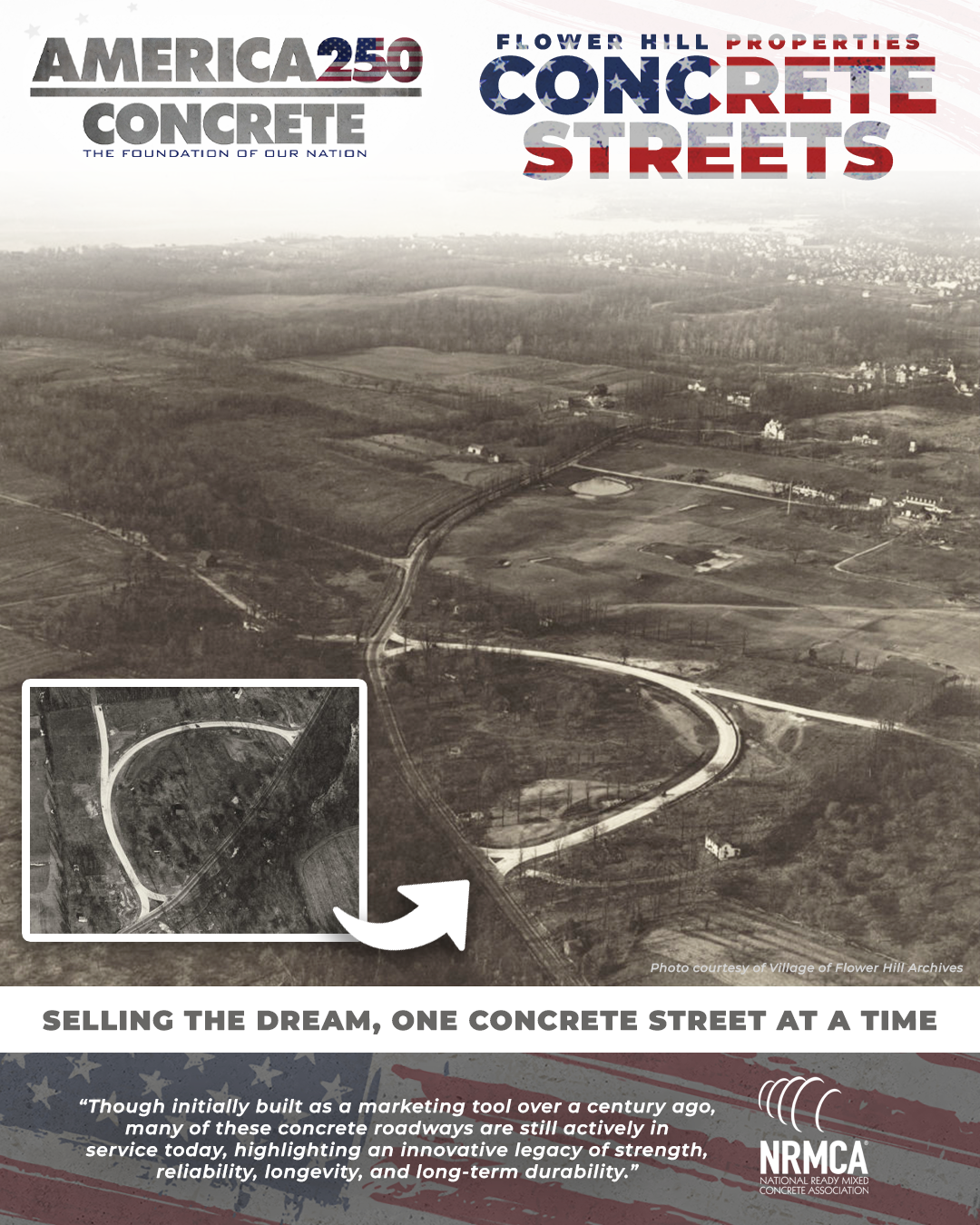
During the early 1920’s, the Cow Neck Peninsula on the North Shore region of Long Island, NY, was transitioning from agrarian farmlands and sand-mining operations into highly desirable “Estate Villages” for Manhattan’s elite.
In 1923, the developers of the exclusive Flower Hill Properties subdivision near Port Washington were looking specifically to attract affluent homebuyers. To do so, they made a major infrastructure investment by constructing 12 miles of concrete pavement for its streets.
Concrete was already highly favored by early automotive and racing enthusiasts for its exceptional strength and durability compared to traditional dirt or macadam roads, as exemplified by William Kissam Vanderbilt II’s Long Island Motor Parkway (to be featured in a future America 250 Concrete highlight). But at a time when pristine, mud-free streets were a luxury, the Flower Hill Properties developers marketed their concrete streets as a premium selling point.
According to a 1925 article in Concrete Highway Magazine, the pavement was “26 feet wide… laid on a 60-foot roadway. [It was] made up of two 10-foot sections and two 3-foot valley gutters built separate from the pavement and dowelled to it.” The pavement was six inches thick with wire mesh reinforcement and had a longitudinal center joint, with expansion joints every 40 feet.
Much to the delight of the developers, the Concrete Highway Magazine article attributed a significant rise in local home sales directly to the clean, smooth concrete streets.
The neighboring village of Lynbrook took note of the improved appearance and performance of the concrete streets, and voters approved a series of bond issues in 1923 and 1924 that resulted in another 12 miles of concrete street construction within their community.
This momentum quickly spread to other adjacent villages, including East Rockaway and Valley Stream. By the spring of 1928, a four-mile diameter area of incorporated villages boasted an impressive total of 47 miles of concrete-paved streets.
Though initially built as a marketing tool over a century ago, many of these concrete roadways are still actively in service today, highlighting an innovative legacy of strength, reliability, longevity, and long-term durability.
(Special thanks to International Society for Concrete Pavements and the American Concrete Pavement Association for content in this article).